Problem
Leaf surfaces do not reflect light uniformly. Their anatomy, pigments and microscopic roughness change how radiation is scattered through a canopy, yet many canopy models use simplified optical inputs. Measuring directional reflectance leaf by leaf is slow, so the question is whether easier-to-measure traits can stand in for it.
Approach
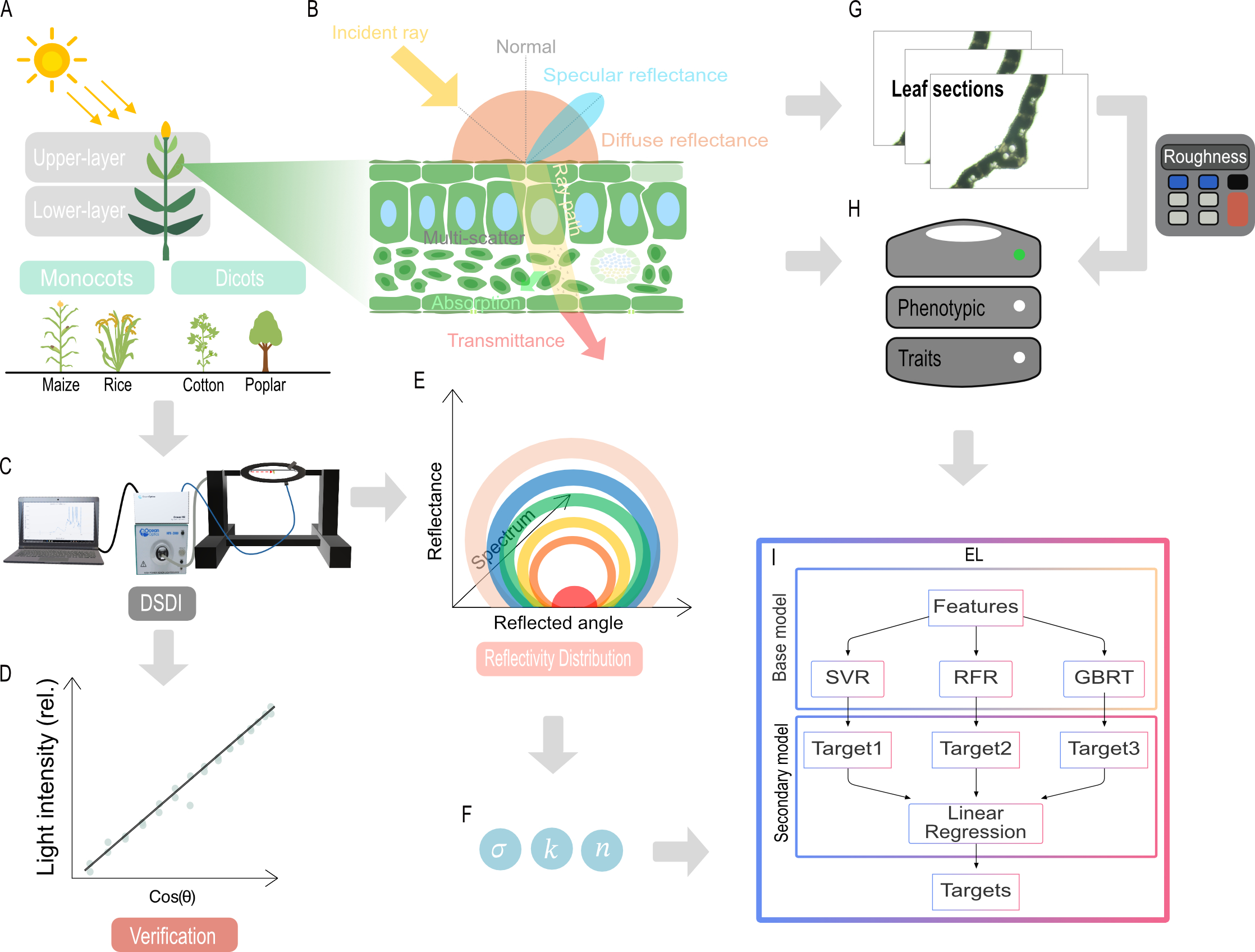
- Measure directional reflectance. A custom Directional Spectrum Detection Instrument (DSDI) — xenon source, fibre spectrometer, mechanically controlled illumination and viewing angles — measured both leaf surfaces at 400–1000 nm, calibrated against a Lambertian white reference.
- Fit a physical model. A Cook–Torrance BRDF represents diffuse and specular reflection with three wavelength-dependent parameters, fitted by adaptive grid search and least squares.
- Predict optics from traits. A stacking ensemble (SVR, random forest and gradient boosting, with a linear meta-learner) maps leaf thickness, specific leaf weight, pigments, microscopy-derived roughness and wavelength to the BRDF parameters.
- Test canopy consequences. Predicted parameters were fed into a rice-canopy ray-tracing workflow based on fastTracer.
| Parameter | Physical interpretation | Related leaf properties |
|---|---|---|
| σ(λ) | Microfacet roughness | Epidermal texture and surface irregularity |
| k(λ) | Diffuse reflection coefficient | Internal scattering |
| n(λ) | Refractive index | Refraction and interface reflection |
Move the sliders to see how each parameter shapes the reflectance pattern: lower roughness concentrates light in a sharp lobe around the mirror direction, while the diffuse coefficient lifts the whole curve evenly.
- Peak
- 0.139 sr⁻¹ at 85°
- Diffuse level k/π
- 0.095 sr⁻¹
- Specular share at the mirror angle
- 18%
Figure 2. Interactive Leaf BRDF in the principal plane
Computed in your browser with the study's Cook–Torrance model, as implemented in its fitting code. Slider ranges are the fitting bounds; the starting values are the code's initial guesses, not a measured leaf. Fitted values for each species are reported in the paper.
Source: doi:10.1016/j.plaphe.2025.100135 · Code
Results
- Material: maize, rice, cotton and poplar leaves from upper and lower canopy positions, both leaf surfaces.
- Model fit: BRDF fitting R² > 0.95.
- Prediction: ensemble prediction R² = 0.83–0.99, depending on the parameter.
What the results support:
- Directional leaf reflectance can be represented accurately with a physically based BRDF model.
- Structural and biochemical leaf traits carry useful information for predicting BRDF parameters.
- Leaf optical diversity can materially change simulated canopy light fields and should not always be treated as uniform.
This connects leaf-scale phenotyping to radiative-transfer and canopy-photosynthesis models.
Limitations
The model was developed from 270 data entries spanning four species, two canopy positions and both leaf surfaces. It is a research model, not a universal estimator.
- Predictions outside the measured trait and wavelength ranges need new validation.
- The ray-tracing results show changes in simulated light distribution; they do not by themselves demonstrate yield gains in the field.
- Direct optical measurement remains important for new species or when high-accuracy optical parameters are required.
- Future datasets should cover more genotypes, environments, developmental stages and water-status conditions.
Code and data
- BRDF fitting scripts and Roughness Calculator
- fastTracer canopy ray-tracing software
- The study data are available from the corresponding author upon reasonable request, as stated in the published article.